
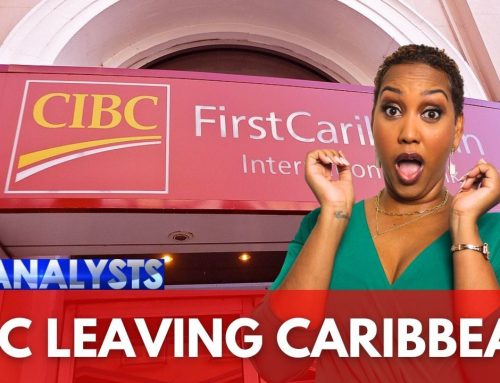
CIBC Caribbean CEO Mark St. Hill says the bank’s planned acquisition by Butterfield will create the largest banking institution in the English-speaking Caribbean and position the combined company for long-term growth across the region.
Speaking on Taking Stock with Kalilah Enriquez Reynolds, St. Hill sought to reassure customers that the US$1.8 billion transaction will bring scale and new opportunities rather than disruption.
“CIBC Toronto is selling its full shareholding in CIBC Caribbean, and that deal will involve a consideration of both cash and shares, which will result in CIBC Toronto having a 22% stake in something much bigger,” St. Hill explained.
He acknowledged that parent company CIBC sees an opportunity to expand its North American operations but emphasized that the Canadian bank is not completely exiting the region.
“CIBC sees an opportunity to expand its North American operations and this transaction will provide necessary capital to allow that. But at the same time, the deal is structured in a way that they will have a 22% minority shareholding in what will be the biggest bank in the English-speaking Caribbean,” he said.
A LONGSTANDING RELATIONSHIP
According to St. Hill, the relationship between the two institutions dates back more than 16 years, when CIBC and a group of investors participated in a major capital injection into Butterfield.
“Butterfield dates back to the 1800s. It is a significant bank in Bermuda and Cayman with international offices across the world,” he said. “The relationship and the insights of each other have been there for many, many years.”
St. Hill revealed that Butterfield made an unsolicited bid earlier this year, which ultimately led to the transaction.
“After careful due diligence, we felt that the two banks were very complementary and what we would create is something extremely special,” he said.
The combined institution is expected to have approximately US$29 billion in assets.
“When you look at it, you’re talking about US$29 billion in assets,” St. Hill noted. “This is something great for the Caribbean. A strong independent platform is being created that will provide significant scale to all of the markets that we operate in.”
HOW BIG WILL THE NEW BANK BE?
If completed, the transaction would create one of the largest financial institutions headquartered in the Caribbean.
At approximately US$29 billion in assets, the combined Butterfield-CIBC Caribbean group would be significantly larger than most Caribbean banking groups. For comparison, NCB Financial Group reported assets of roughly US$14 billion at the end of its last financial year, while JMMB Group’s assets are approximately US$7 billion.
The comparison with Sagicor Financial is more complex. Sagicor reported more than US$25 billion in assets under management and operates a broader insurance, pension, investment and banking business spanning the Caribbean, United States and Canada.
As a result, St. Hill’s claim that the combined entity would become the largest bank in the English-speaking Caribbean appears broadly accurate based on total banking assets. However, Sagicor remains one of the region’s largest overall financial services groups when insurance and investment assets are included.
‘BUSINESS AS USUAL’ FOR CUSTOMERS
While the announcement has sparked concerns among customers, particularly those loyal to the CIBC brand, St. Hill said there will be little immediate change.
“In the next 10 to 12 months, it is business as usual,” he said, explaining that the deal must first go through a lengthy regulatory approval process across multiple jurisdictions.
Once the transaction closes, customers will eventually see the Butterfield brand emerge, but St. Hill stressed that operations, management teams and customer relationships will remain largely intact.
“There’s not going to be a massive sea change to our clients, our relationship teams. The management continues, everything continues as is,” he said.
He said the integration process would be gradual, with the Butterfield brand likely being introduced over an 18- to 24-month period following regulatory approval and closing.
NOT A COST-CUTTING EXERCISE
St. Hill repeatedly emphasized that the transaction is not being driven by cost reductions or branch closures.
“This transaction is not driven by large cost synergies. It is about two great institutions coming together and bringing together their special niche,” he said.
Butterfield’s strengths include wealth management, trust services and mortgage lending, while CIBC Caribbean brings significant expertise in commercial and corporate banking.
“We intend that when we combine, especially, to bring a very powerful small business offering to the region,” St. Hill said.
He also revealed that the Caribbean management team will remain in place following the acquisition.
“The management of the Caribbean operations will continue to be run through the Caribbean head office in Barbados,” he said. “They’re not only buying a book, they’re buying the management, the talent, the system, the culture.”
According to St. Hill, commitments have already been made to regulators and governments regarding the maintenance of branches, employment and management structures throughout the region.
DEFENDING THE CARIBBEAN BRAND
The CEO also pushed back against the notion that CIBC Caribbean’s success is primarily the result of Canadian expertise.
“Our own University of the West Indies has produced over 90 per cent of the talent that has created the award-winning app,” he said. “All of these things are built, manufactured and deployed in the Caribbean.”
St. Hill argued that while the CIBC logo may eventually disappear, the people behind the brand will remain.
“What has really made the affection to our Caribbean people… is done by Caribbean people, and those Caribbean people are the ones that are going to go forward with this new entity, Butterfield,” he said.
“I have told repeatedly to my 3,000 staff: brands are the people.”
MORE COMPETITION, NOT LESS
Addressing concerns about consolidation in the regional banking sector, St. Hill said he believes customers will ultimately benefit from increased competition.
“What I will say is that the competition is going to become more fierce amongst the banks and when competition becomes more fierce, I believe the consumer wins,” he said.
Rather than focusing on Canadian banks reducing their footprint in some markets, he pointed to regional players such as Republic Bank and Butterfield that continue to expand.
“This transaction will move us from 10 jurisdictions to 11 in the Caribbean plus another five international markets,” he said.
BUTTERFIELD SHARES OFFERED TO INVESTORS
St. Hill also revealed that minority shareholders will have the option to receive Butterfield stock as part of the takeover process.
“What we are going to provide is the option… to elect to receive 100 per cent of their consideration in Butterfield shares,” he said.
Butterfield is listed on the New York Stock Exchange under the ticker NTB, giving Caribbean investors exposure to a larger regional banking group through an internationally traded stock.
The transaction remains subject to regulatory approvals across multiple jurisdictions and is expected to take approximately 10 to 12 months before closing. During that period, St. Hill said customers should expect business as usual while the two institutions work toward creating what he described as “something very great” for the Caribbean.








Leave A Comment