Should Trinidad devalue its currency?
We’ve spoken a lot in the last year about Trinidad and Tobago’s forex crisis. The country is not earning as much US dollars as it used to because it’s not exporting as much oil, which accounts for 80% of Trinidad’s exports.
That’s been putting pressure on the USD that is already in the country, leading to foreign exchange shortages. Some banks have even cut the amount you can spend on a credit card to as low as a hundred US dollars per month.
Now Trinidad’s Central Bank uses what’s known as a “managed float” to manage the exchange rate. This is kinda like a hybrid between a fixed exchange rate and a floating rate.
For example, Belize has a fixed exchange rate, where the currency is pegged to the US dollar at 2 to 1. While Jamaica has a floating exchange rate, where the value of the JMD moves every day in response to supply and demand.
In 1993, T&T moved from a fixed rate to a managed float. At the time the TT dollar was about 4 to 1 US. It depreciated to around 6 to 1 after the change, and the Central Bank has kept it roughly there ever since, by intervening in the market to prevent big swings.
Technically, this is similar to what the Bank of Jamaica has been doing to keep the JMD from sliding too far too quickly. But in practice, what was supposed to be a “managed float” has once again become a fixed exchange rate.
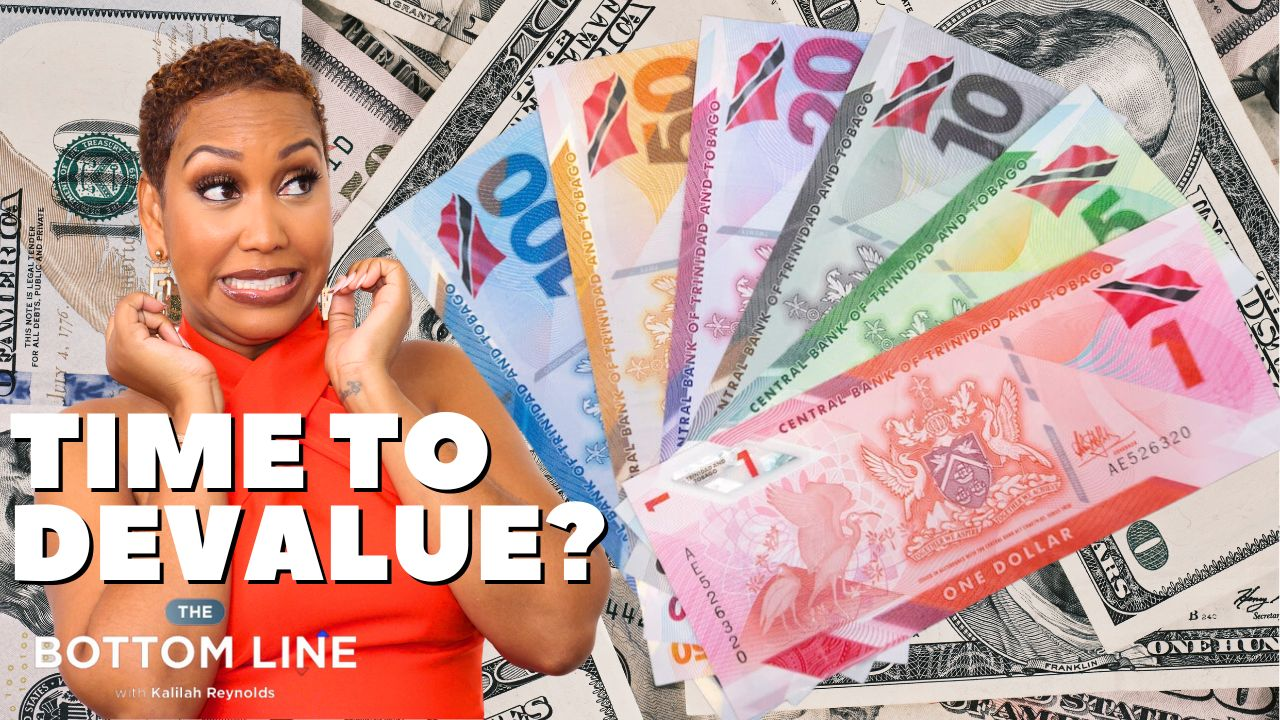
Trinidad’s official exchange rate has been locked at TT$6.80 to US$1 for almost ten years. But that’s just the official rate. Unofficially, people are paying up to TT$9 for US$1 on the black market, which is said to be thriving.
One solution being proposed is to allow the TTD to devalue to 9 dollars, which naturally, has stirred a lot of controversy.
Proponents include businessman Emile Elias, who’s written to Prime Minister Kamla Persad-Bissessar requesting devaluation to TT$9.
He argues that the black market would disappear overnight, exports would rise, and investment inflows would increase. He says demand would also normalise once citizens and businesses can reliably access US dollars through the banking system at the correct price.
According to Elias, critical projects have been stalled because USD for imported equipment and materials can’t be sourced.
But on the other hand, devaluing to TT$9 would also have significant consequences. That’s a 32% fall, which would affect the cost of goods and services, especially for imported items, leading to a sharp rise in inflation.
Several economists have since warned that it would be a dangerous move.
They argue that because Trinidad’s forex woes are directly tied to a decline in its oil and gas market, devaluing the currency won’t help.
Now ExxonMobil did recently signed a new deal with Trinidad’s Government to look for oil and gas offshore. The company could invest as much as US$21.7 billion if it finds major reserves, which would be great news for the twin island republic.
But that won’t happen overnight IF it happens at all. Exploration can take years before producing oil or gas, even for a “mature” provider like Trinidad.
That’s why some economists think that the country should also focus on building other industries to increase exports and earn more USD that way.
And that’s the bottom line.