
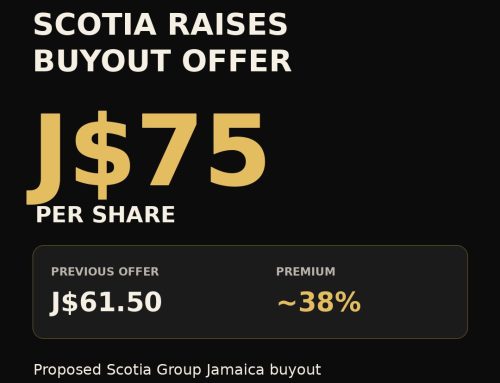
Scotia Group Jamaica shareholders assessing the increased J$75-per-share offer should also consider what happens to their portfolios after a sale, according to Sagicor Investments analysts Oral Russell and Ossey Farr.
Speaking on Money Media’s Taking Stock, the analysts discussed how corporate actions can affect investment income, sector exposure and the balance of a portfolio. Their discussion covered Scotia’s offer, Seprod’s proposed stock split and additional public offering, and Massy’s planned sale of its Caterpillar business line.
The central question was how investors should reassess their holdings when a company changes—or leaves—their portfolios.
Start with why you owned Scotia
Russell said Sagicor’s research team had recommended accepting Scotia’s increased offer, which rose from J$61.50 to J$75 per share.
He described the revised price as close to the team’s valuation and attractive relative to the stock’s trading history.
But deciding what to do with the proceeds requires a separate assessment.
Investors should revisit their objectives, the structure of their portfolios and conditions in the market before selecting replacements, Russell said.
For some shareholders, Scotia provided regular dividend income. For others, it offered exposure to the financial sector. Those purposes should guide the next decision.
Russell identified NCB and Sagicor as financial-sector companies investors could assess. Outside that sector, he mentioned Carreras, TransJamaican Highway and Supreme Ventures as companies to consider when reviewing income opportunities.
These were possibilities raised during the discussion, rather than a single replacement suitable for every shareholder.
Replacing dividend income may require several holdings
Farr highlighted Carreras’ record of dividend payments and its position in Jamaica’s tobacco market.
He said the company’s outlook was supported by its market position, cost management and efforts to respond to changing consumer preferences, including through its Vuse vaping products. He also pointed to efforts to address the illicit cigarette trade.
However, replacing income from Scotia requires more than selecting another company known for dividends.
Farr said shareholders should compare the dividend income they received with what potential replacements could provide. Rebuilding that income stream may require a combination of holdings.
The amount invested, the number of shares purchased and the dividends paid all affect the income a shareholder receives. A company’s past dividend record also does not guarantee future payments.
Farr identified disruption to Carreras’ distribution network as one risk investors should consider, noting that its cigarettes are manufactured outside Jamaica.
A stock split changes the share count
The analysts also discussed Seprod’s proposed five-for-one stock split and potential additional public offering.
Russell explained that, under a five-for-one split, an investor holding one share would hold five afterwards. The corresponding adjustment to the price means the split itself does not increase the value of that holding.
A lower price per share could make smaller purchases more accessible, but any subsequent price appreciation would depend on market activity. It is not created automatically by the split.
An additional public offering raises a different question. Issuing new shares can dilute an existing shareholder’s percentage ownership if that shareholder does not participate proportionately.
The discussion highlighted the importance of examining how the company intends to use the funds raised.
Russell said investors should assess whether the proceeds would reduce debt or support profitable growth. Farr linked the potential fundraising to Seprod’s broader efforts to strengthen its balance sheet following acquisitions.
The proposals discussed on the programme remained subject to the relevant shareholder approvals and subsequent decisions.
Massy’s sale puts the use of proceeds in focus
Farr described Massy’s proposed sale of its Caterpillar business line as part of a wider effort to redeploy capital into areas with stronger growth potential.
He said investors should consider the transaction alongside the group’s work to expand distribution and logistics, including investments in Trinidad and planned capacity in Guyana.
Farr cautioned that divestments could put pressure on near-term profits, while arguing that the longer-term outcome would depend on how effectively the company used the released capital.
For shareholders, the sale price is therefore only one part of the assessment. The earnings impact, the businesses retained and the returns from subsequent investments also matter.
Borrowing adds another layer of risk
An audience question asked whether investors should borrow to buy a stock such as Seprod.
Russell cautioned that future share-price gains are uncertain, while borrowing creates a repayment obligation. Investors taking that approach could face financing costs without the market gains they expected.
Across the discussion, the analysts returned to the same starting point: review your goals and the role each investment plays before reacting to a corporate announcement.
This article reports the analysts’ views for educational purposes. It is not personalised investment advice.
Watch the full Analysts discussion on Taking Stock.





Leave A Comment