
TransJamaican Highway’s stronger revenue and profit have attracted renewed investor interest, but its sharp share-price gains raise questions about valuation and Jamaica’s stock-market recovery.
TransJamaican Highway (TJH) emerged as one of the notable performers on the Jamaica Stock Exchange, with its share price climbing nearly 60 per cent in just over a month.
The stock rose from approximately J$8 at the beginning of July 2026 to a peak of J$12.70 on August 5, supported by stronger financial results and growing investor interest.
But did the rally make TJH an attractive investment, or had investors already priced in much of its future growth? Sagicor Business Development Advisor Monique Wilson discussed that question on Money Media’s Taking Stock with Kalilah Reynolds.
Stronger earnings support investor interest
TJH reported revenue of approximately US$57 million for the first six months of 2026, a 28 per cent increase over the comparable period. Net profit climbed approximately 40 per cent to US$25 million, compared with US$18 million a year earlier.
Revenue from the Williamsfield leg exceeded initial projections, while rising traffic volumes and lower financing costs supported profitability. TJH has also been reducing debt and exploring opportunities to operate additional sections of Jamaica’s highway network, including the Montego Bay Perimeter Road.
A good company isn’t always a cheap stock
At J$12.70, TJH was trading at approximately 24 times trailing earnings. The rising share price also reduced the dividend yield available to new buyers.
Wilson expressed confidence in TJH’s underlying business while acknowledging that speculation had helped drive the rally.
“There is a split opinion across the industry,” she said. She outlined a conservative share-price expectation of approximately J$14 to J$15 by December 2026 or January 2027, while noting that other forecasts reached J$20.
Those were her assessments at the time of the August interview, not guaranteed returns or updated share-price targets.
Is Jamaica’s stock-market recovery real?
Although the Jamaica Stock Exchange Main Market gained more than 11 per cent during the first half of 2026, many individual stocks remained under pressure.
“We’re still in a bearish market, but with some bullish plays,” Wilson said. She explained that much of the growth was concentrated in a relatively small number of stocks rather than spread evenly across the market.
That distinction matters: a headline index can rise even when many constituent companies continue to struggle.
Scotia’s proposed exit could redirect investment
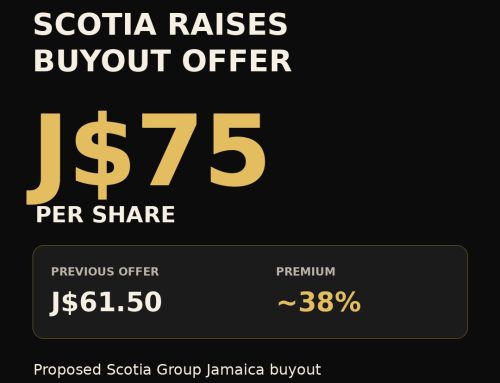
Wilson also identified Scotia Group Jamaica’s then-proposed minority-shareholder buyout as a possible contributor to investor repositioning. At the time of the August interview, investors were considering a proposed acquisition at J$61.50 per share.
Investors accustomed to Scotia’s dividends were examining alternatives, potentially directing money towards Carreras, TJH and other income-oriented stocks. Wilson observed that some large investors were repositioning before the transaction had been finalised.
The J$61.50 figure reflects the proposal at the time of the interview, not the latest offer price.
What investors should consider
TJH’s future performance depends on traffic volumes, toll revenue, operating costs, borrowing expenses, dividends and potential highway expansion opportunities. Investors must also assess toll regulation, maintenance, financing and concentration risk.
Wilson’s broader point was that improving investor sentiment does not replace careful company analysis. A financially strong business is not necessarily an attractive purchase at every share price.
Based on Monique Wilson’s discussion on Taking Stock, Episode 329, in August 2026. Prices, valuations and projections reflect the interview period, not current market levels. This article is for financial education and is not personalised investment advice.







Leave A Comment